Ledged and braced door
projects.ledged_and_braced_door
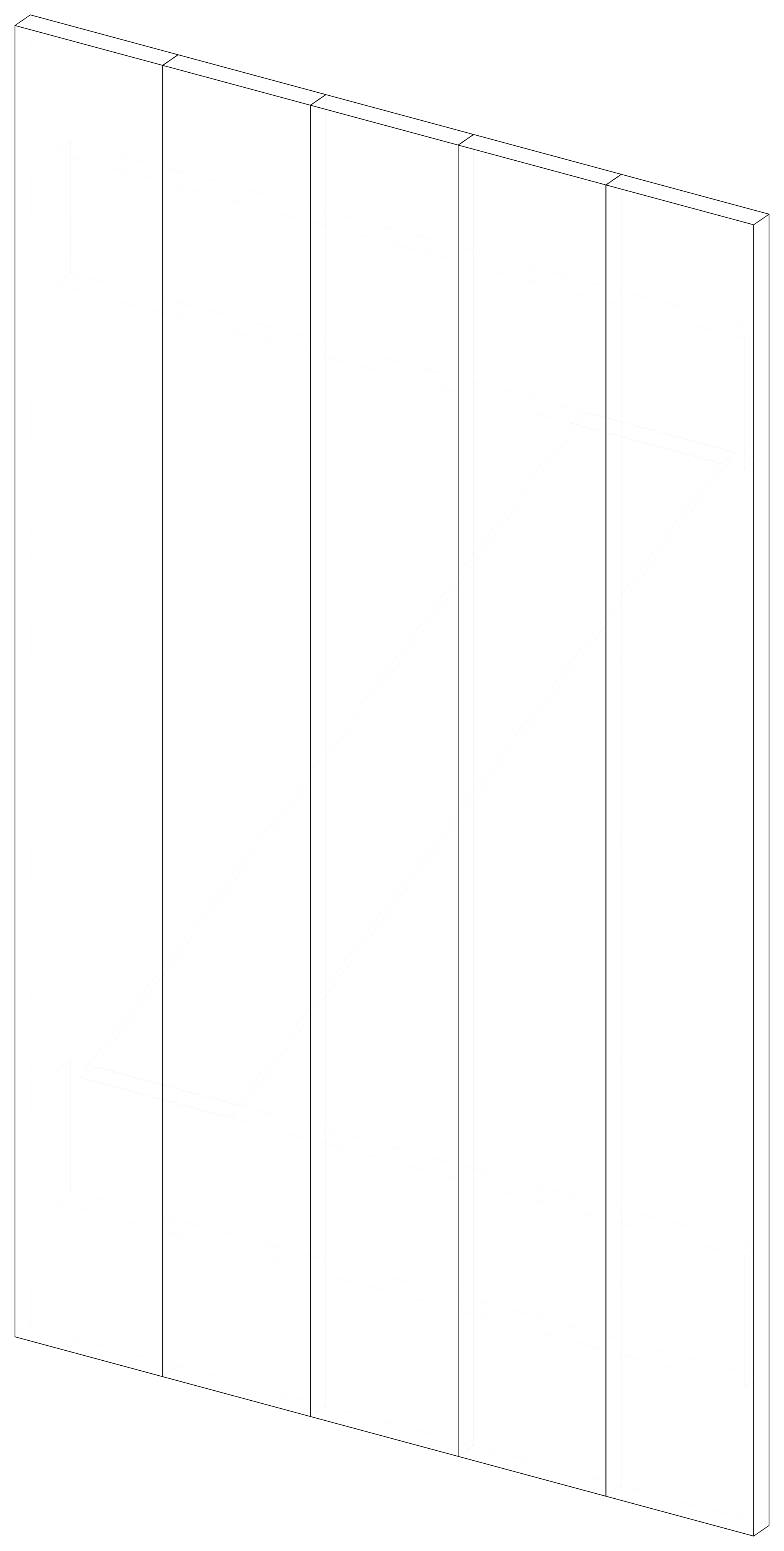
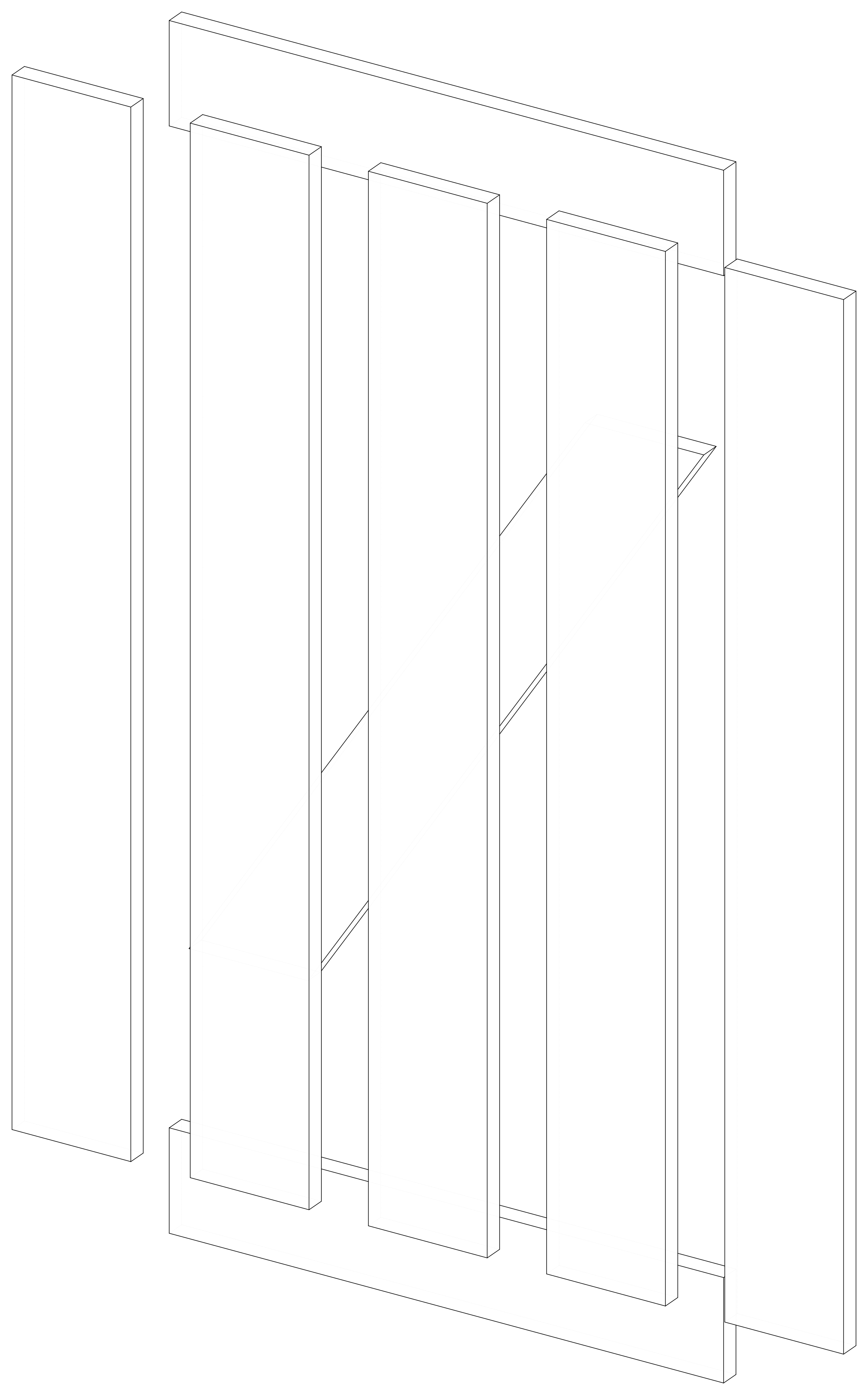
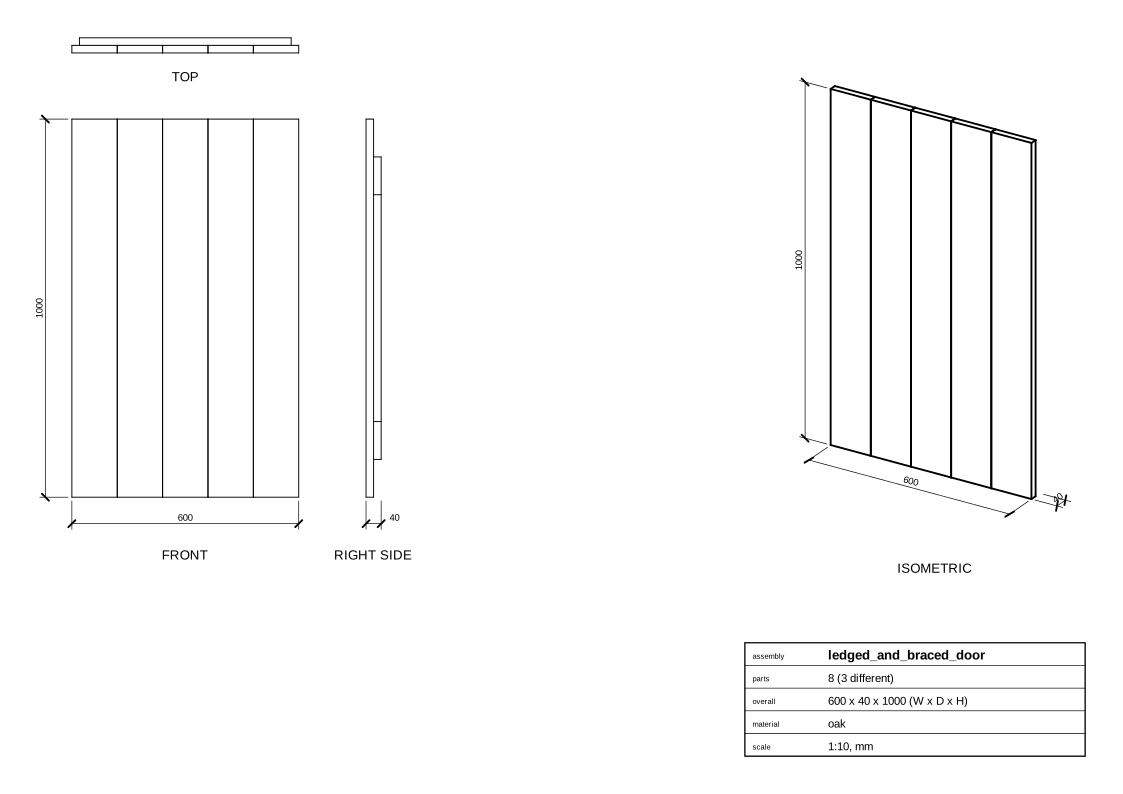
A ledged and braced door, e.g. for a shed: boards butted edge to edge on two ledges and a diagonal brace across the back.
The boards aren't glued: they would be nailed or screwed to the ledges
and the brace from the front (not modelled). The ledges lie
ledge_from_ends from the top and the bottom, ledge_inset in from
the sides. The brace lies between them, in the same plane, and keeps
the door from sagging: it rises from the hinge side (the left, seen
from the front) at the bottom ledge to the latch side at the top one,
so that it is in compression. Its ends are cut level and bear against
the ledges' edges, the long points brace_inset in from the ends of
the ledges.
Parameters
| Parameter | Default |
|---|---|
height |
1000 |
width |
600 |
boards |
5 |
ledge_width |
100 |
ledge_from_ends |
100 |
ledge_inset |
20 |
brace_width |
100 |
brace_inset |
20 |
stock |
20 mm board, oak |
Change them in a design file (see Change an example):
Drawings
The plans in one PDF: plans.pdf.
Assembly
Parts
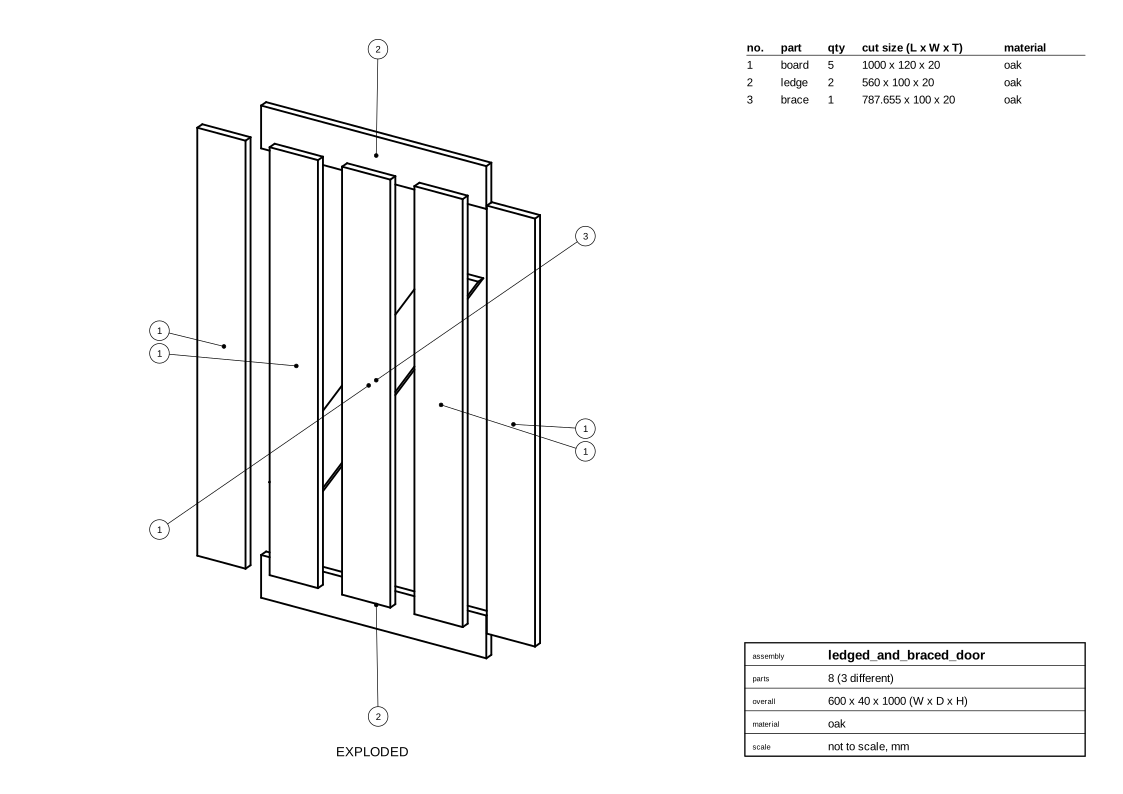
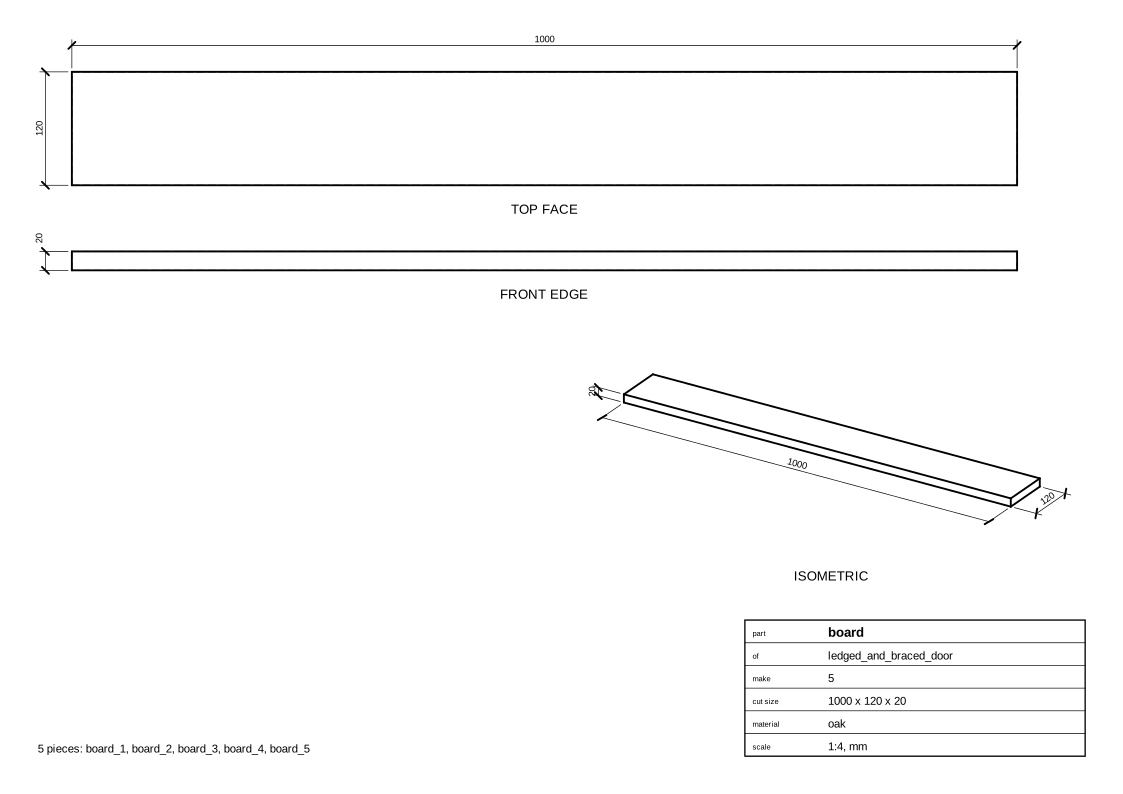
Board
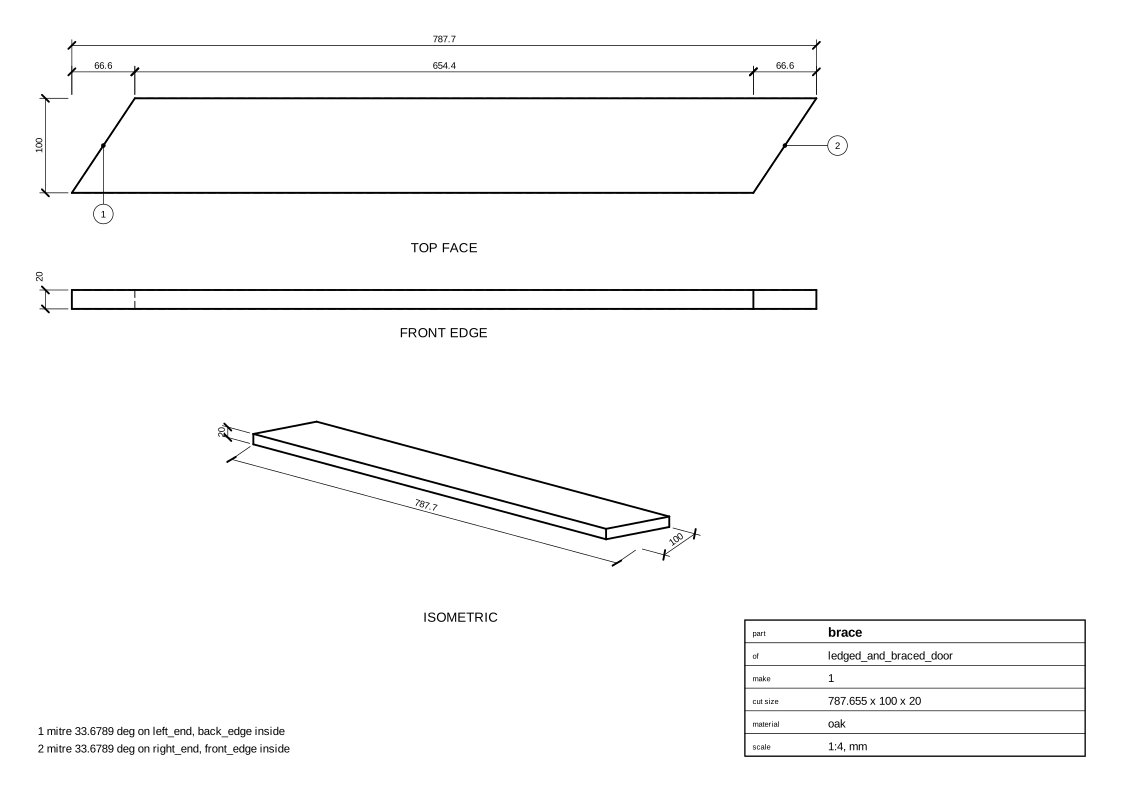
Brace
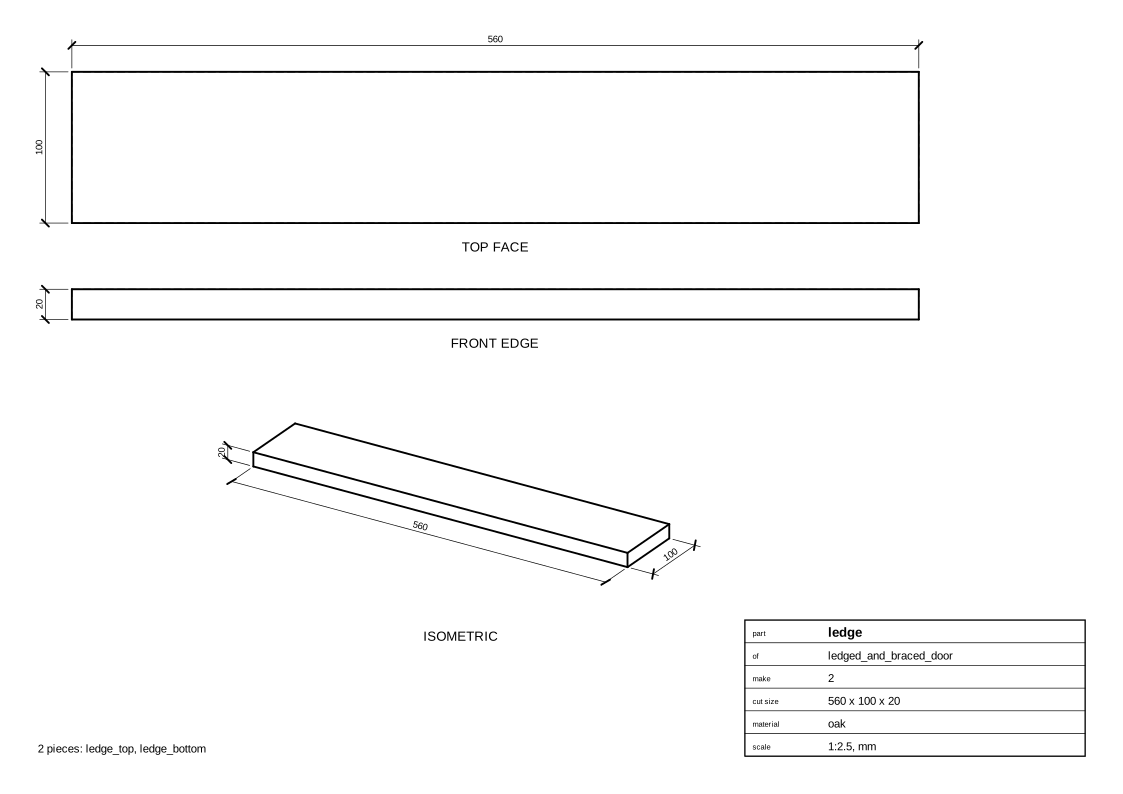
Ledge
Cut list
board  1000 x 120 x 20 mm  oak, 5 pieces: board_1, board_2, board_3, board_4, board_5
ledge  560 x 100 x 20 mm  oak, 2 pieces: ledge_top, ledge_bottom
brace  787.655 x 100 x 20 mm  oak
       - mitre 33.6789 deg on left_end, back_edge inside
       - mitre 33.6789 deg on right_end, front_edge inside
Code
From woodwright/examples/projects.py, which imports the names it uses (see From an example to your own design):
def ledged_and_braced_door(
    height: float = 1000,
    width: float = 600,
    boards: int = 5,
    ledge_width: float = 100,
    ledge_from_ends: float = 100,
    ledge_inset: float = 20,
    brace_width: float = 100,
    brace_inset: float = 20,
    stock: Stock = OAK,
) -> Assembly:
    """A ledged and braced door, e.g. for a shed: boards butted edge to edge
    on two ledges and a diagonal brace across the back.

    The boards aren't glued: they would be nailed or screwed to the ledges
    and the brace from the front (not modelled). The ledges lie
    `ledge_from_ends` from the top and the bottom, `ledge_inset` in from
    the sides. The brace lies between them, in the same plane, and keeps
    the door from sagging: it rises from the hinge side (the left, seen
    from the front) at the bottom ledge to the latch side at the top one,
    so that it is in compression. Its ends are cut level and bear against
    the ledges' edges, the long points `brace_inset` in from the ends of
    the ledges.
    """
    # The boards' reference faces are at the back, their back edges to the right.
    asm = Assembly("ledged_and_braced_door", root_location=STANDING)
    door = [
        asm.add(Board(f"board_{i + 1}", stock, length=height, width=width / boards))
        for i in range(boards)
    ]
    for a, b in itertools.pairwise(door):
        asm.join(Butt(a.back_edge, b.front_edge))
    first = door[0]
    for name, end in [("top", first.right_end), ("bottom", first.left_end)]:
        ledge = asm.add(
            Board(f"ledge_{name}", stock, length=width - 2 * ledge_inset, width=ledge_width)
        )
        asm.join(
            Butt(
                first.top_face,
                ledge.bottom_face,
                position=offset(ledge_from_ends, ref=end),
                flush=(first.front_edge, ledge.left_end),
                across=offset(ledge_inset),
            )
        )
    # The brace's long points, on its upper (front) edge at the bottom and
    # its lower (back) edge at the top, lie on the ledges' edges, `run` apart
    # across the door and `rise` apart up it: its slope makes the brace's
    # width fit between them.
    rise = height - 2 * (ledge_from_ends + ledge_width)
    run = width - 2 * (ledge_inset + brace_inset)
    slope = math.atan2(rise, run) + math.asin(brace_width / math.hypot(run, rise))
    length = (rise + brace_width * math.cos(slope)) / math.sin(slope)
    brace = asm.add(Board("brace", stock, length=length, width=brace_width))
    end_angle = 90 - math.degrees(slope)
    brace.cut(Mitre(brace.left_end, inside=brace.back_edge, angle=end_angle))
    brace.cut(Mitre(brace.right_end, inside=brace.front_edge, angle=end_angle))
    # Lying along the top of the door, the brace is turned down about its
    # lower long point, on the bottom ledge (measured from the top).
    asm.join(
        Butt(
            first.top_face,
            brace.bottom_face,
            position=offset(height - ledge_from_ends - ledge_width),
            flush=(first.front_edge, brace.left_end),
            across=offset(ledge_inset + brace_inset),
            angle=-math.degrees(slope),
        )
    )
    return asm
Exported with woodwright 0.9.0 on 2026-10-25.