Workbench
projects.workbench
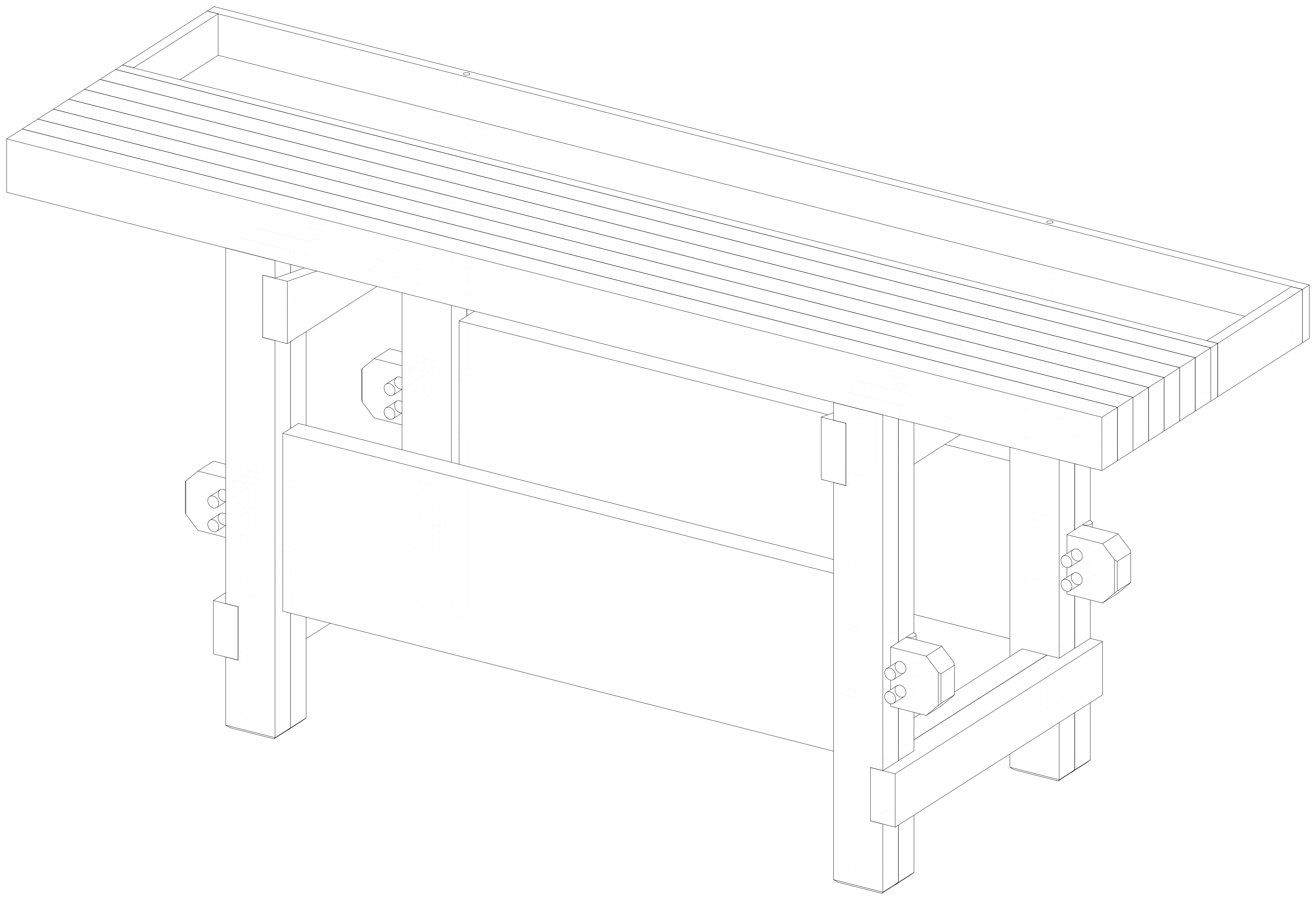
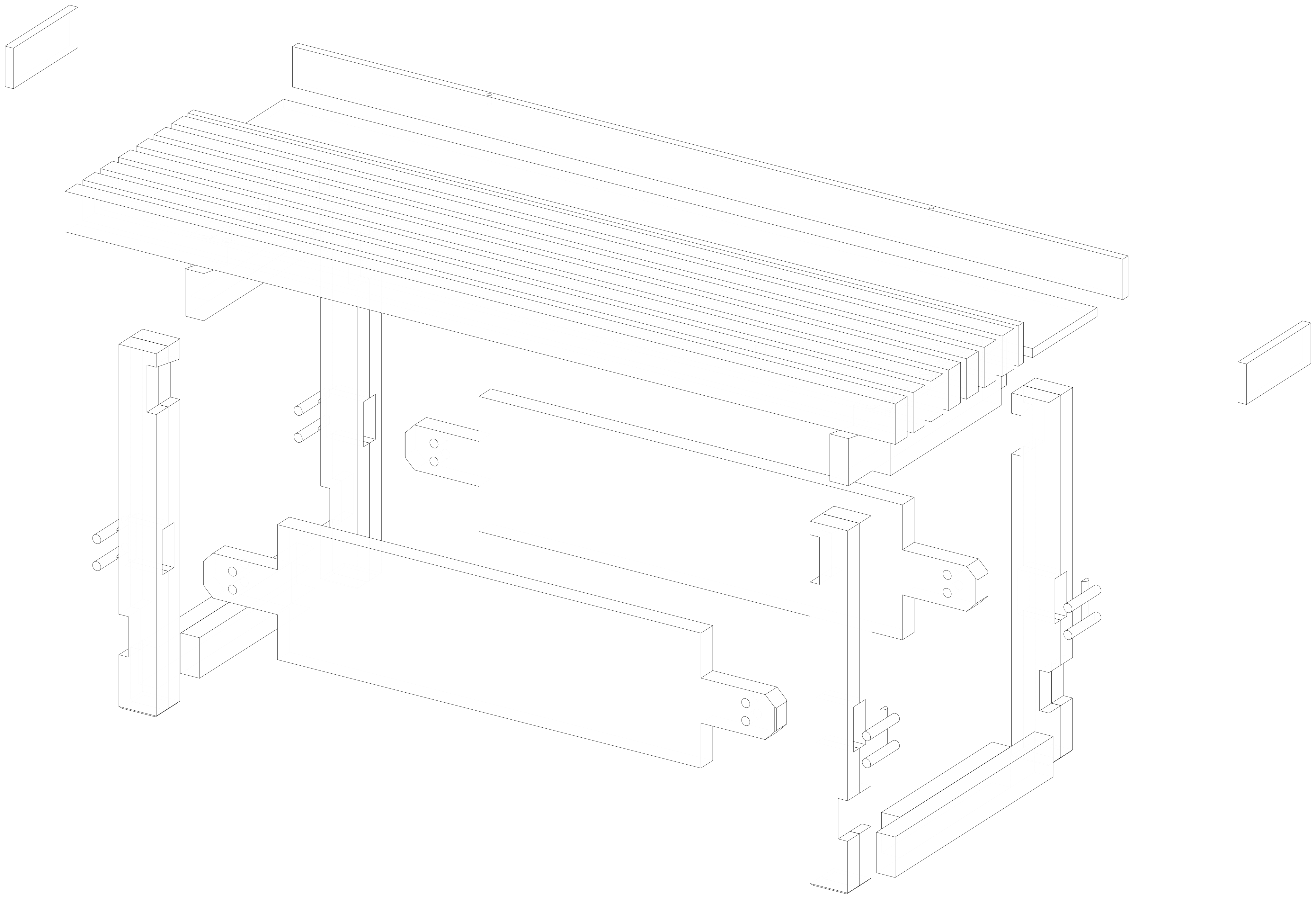
A knock-down workbench, an approximation of Rex Krueger's Quick Stack workbench (get his plans for the real thing, at rexkrueger.com).
Two leg assemblies, length - 2 x overhang apart over the outsides of
the legs, are joined by two wide stretchers with tusk tenons, and carry
a split top height above the floor: a massive desk at the front and a
tray (a drawer-like box) at the back, flush with the legs at the front
and the back, depth deep, overhang beyond the legs at each end.
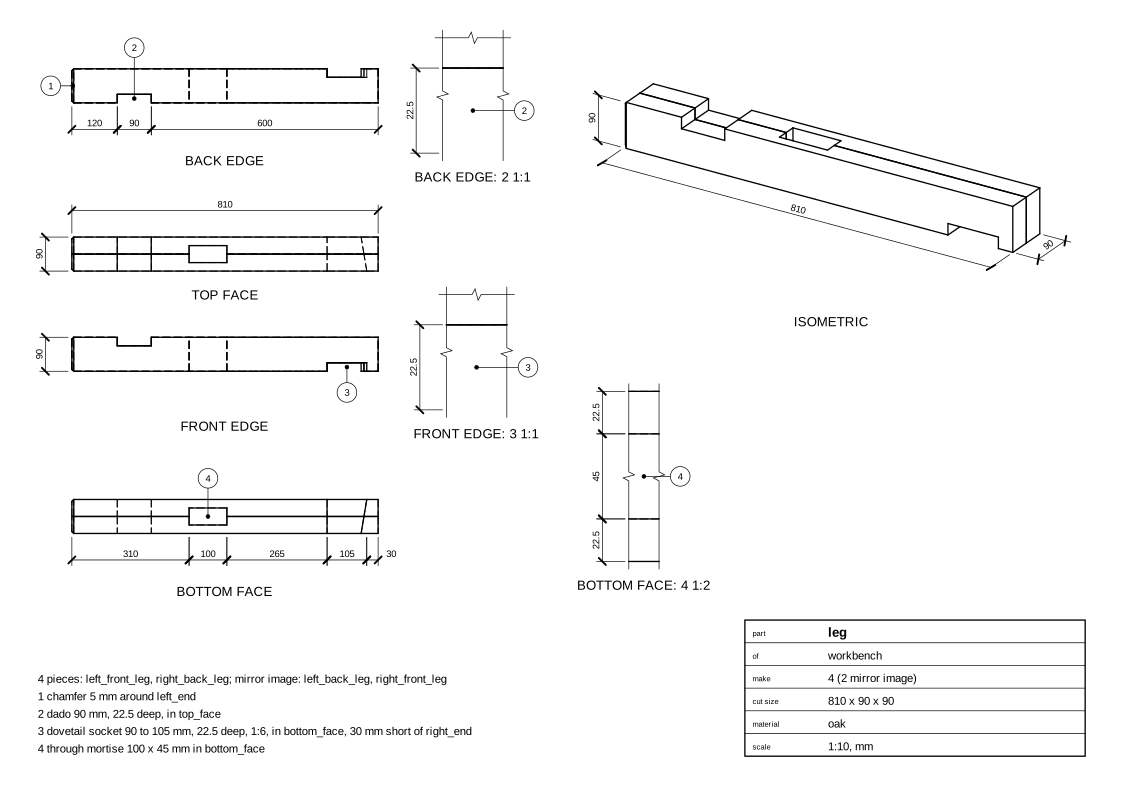
Each leg assembly: two 90 mm square legs, their feet chamfered, and two
rails from front to back, all glued up from two 45 mm boards (the legs'
glue lines on their sides, the rails' upright), the rails flush
with the legs' front and back, lapped across the legs but let in only
partly: the rails are cut to half their thickness, the legs notched a
quarter of theirs, so the rails stand out of the legs by a quarter. The
lower rail, as square as the legs, is on the outside, lower_rail_height
above the floor. The upper one, 90 x 135 mm, on the inside and flush
with the tops of the legs, has its laps cut to half dovetails, flat at
the bottom and sloped at the top: the laps are cut back leg_cap from
the top, so that the legs keep a solid cap above the notches.
The stretchers, 45 mm thick and stretcher_width wide, stand on the
lower rails (or stretcher_height above the floor). Their long through
tenons, as thick as the stretchers and a third as wide, stand out of the
legs by as much as the legs are wide, their corners chamfered big. Each
tenon is held by tusks dowel tusks (in the second and the fourth fifth
of the tenon), level through its thickness, their heads to the front:
20 mm dowels a bit longer than the legs are wide, their flats tapering
over 50 mm at their tips, bearing on a half dowel glued flat side down
on the leg behind the tenon.
The desk is glued up from top_beams 45 x 90 mm beams standing on edge
(as "2x4s"). The tray, of tray_thickness boards, has walls as high as
the desk is thick and a bottom between them, flush with their lower
edges, so that it can be turned over: open side up it holds tools,
upside down it is a flat part of the top. Both sit on the legs and the
upper rails, located by short dowels in the rails: two 20 mm ones into
the desk (into two of its beams) and a 10 mm one into the tray's front
wall on each rail; the back wall has matching holes in its top edge for
the tray turned over.
Parameters
| Parameter | Default |
|---|---|
length |
2000 |
depth |
600 |
height |
900 |
overhang |
400 |
stretcher_width |
300 |
stretcher_height |
None |
lower_rail_height |
120 |
leg_cap |
30 |
tusks |
2 |
top_beams |
7 |
tray_thickness |
20 |
Change them in a design file (see Change an example):
Drawings
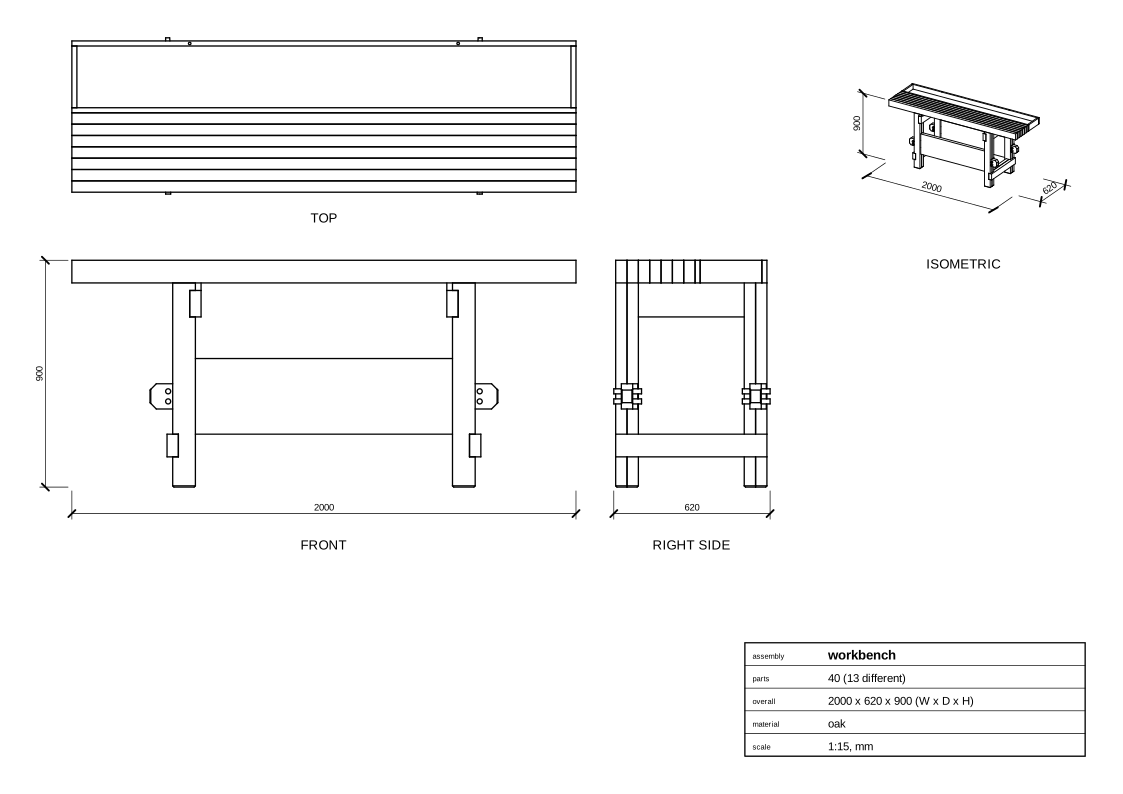
The plans in one PDF: plans.pdf.
Assembly
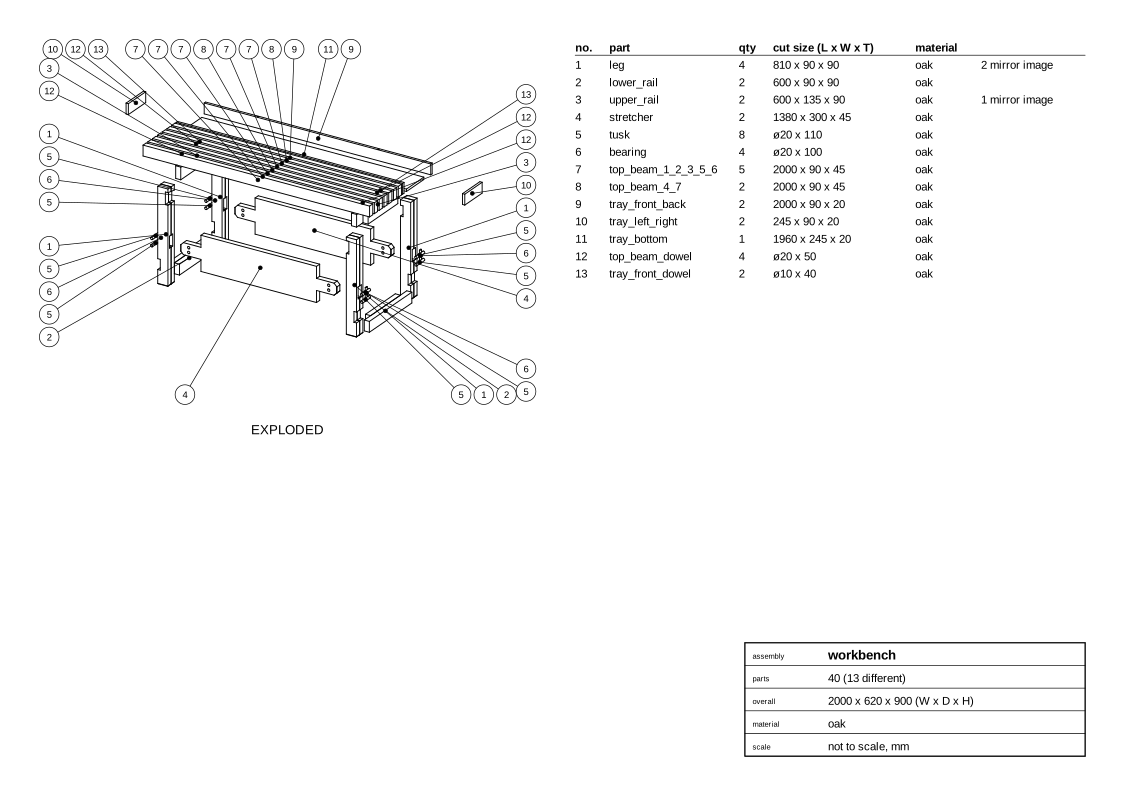
Parts
Bearing
Leg
Lower rail
Stretcher
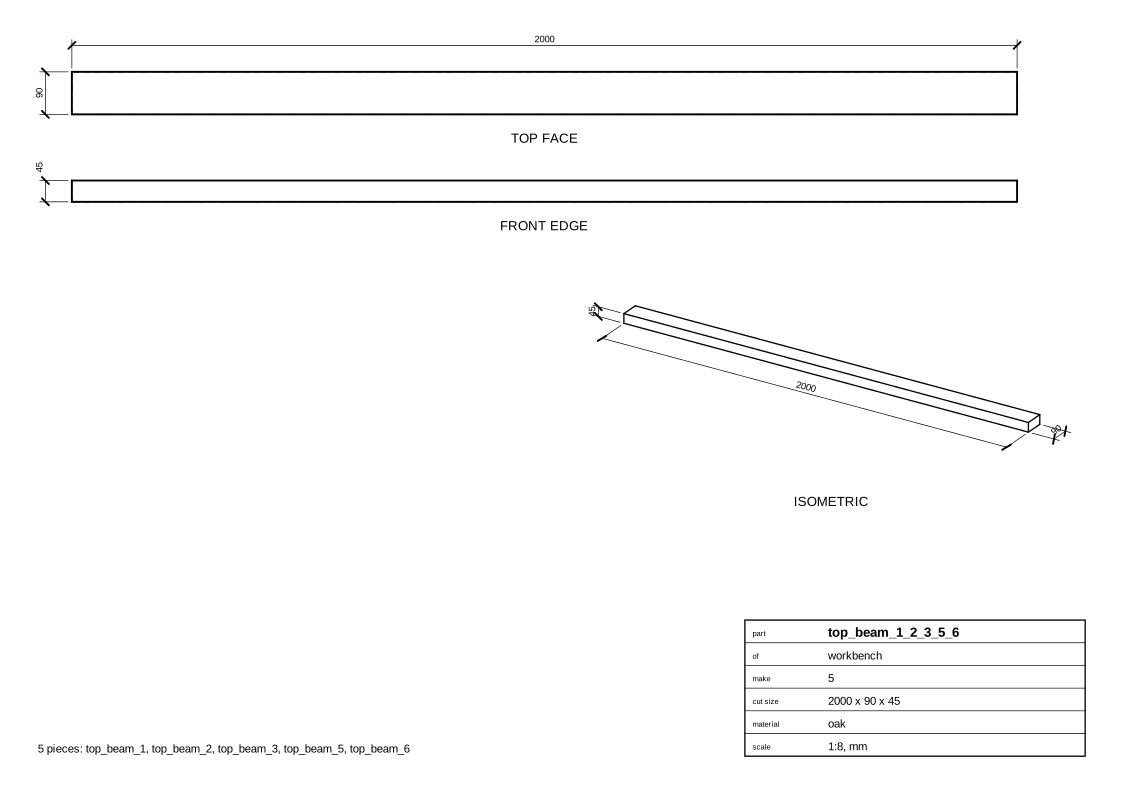
Top beam 1 2 3 5 6
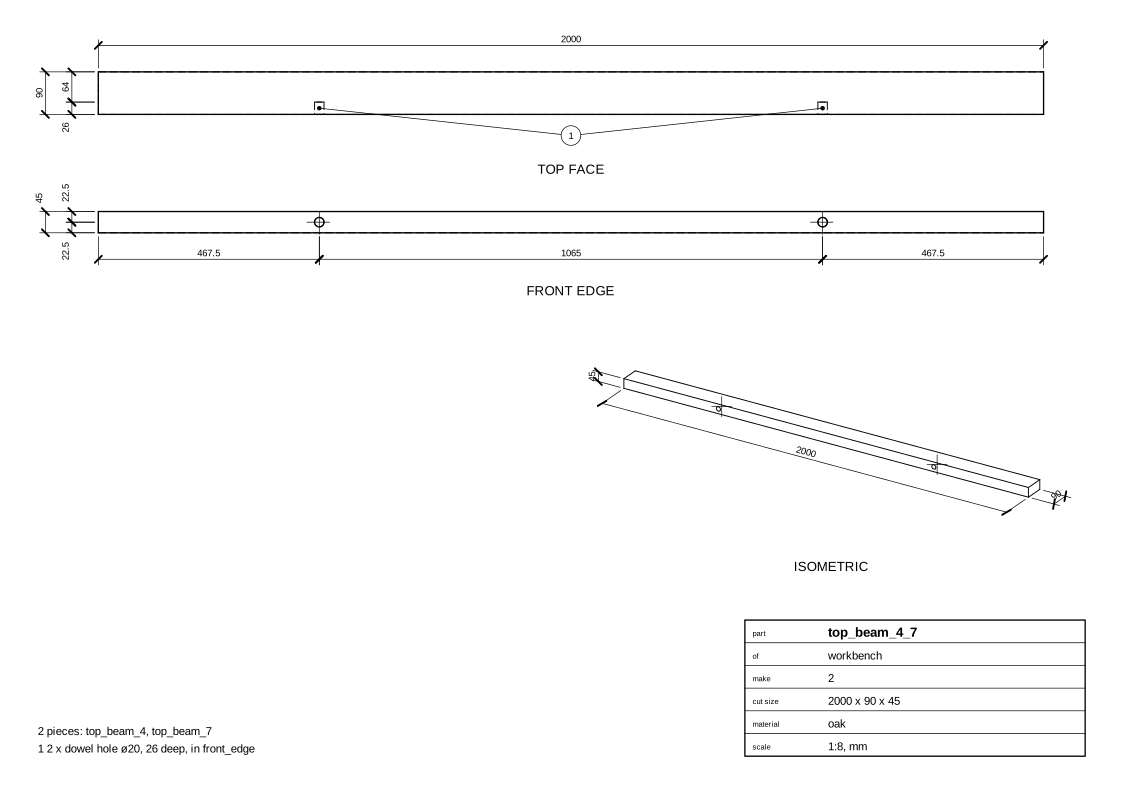
Top beam 4 7
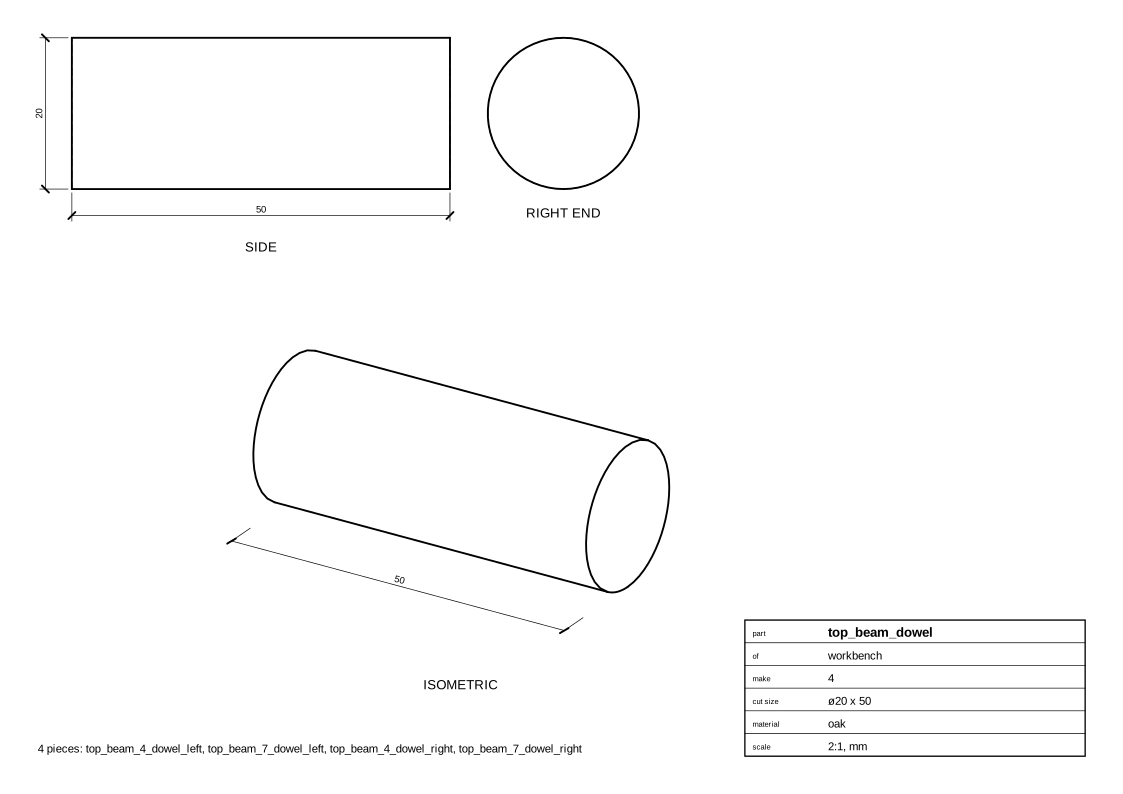
Top beam dowel
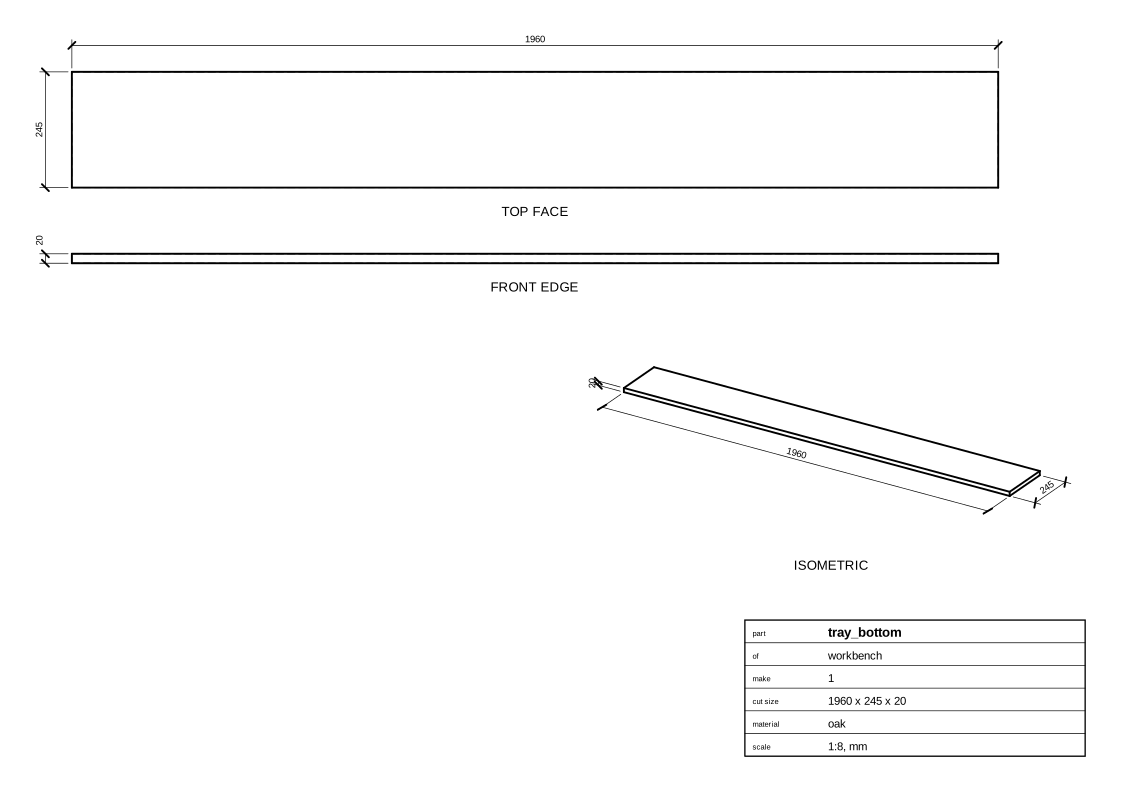
Tray bottom
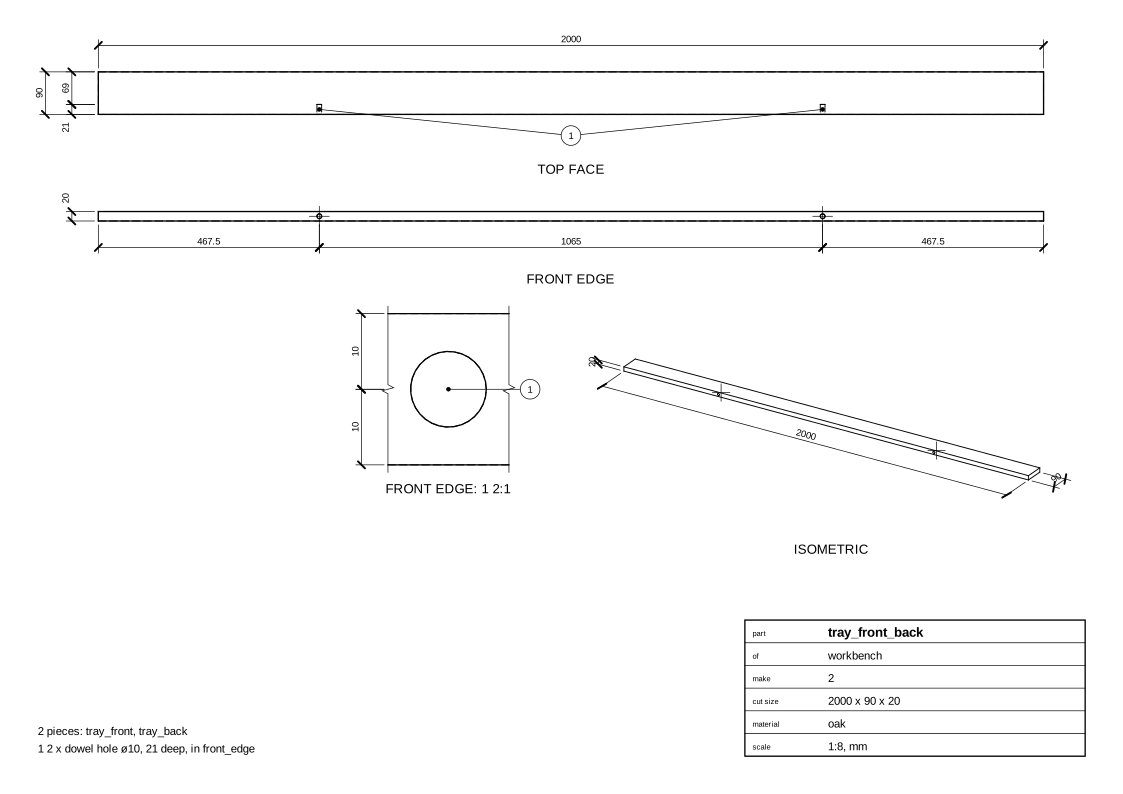
Tray front back
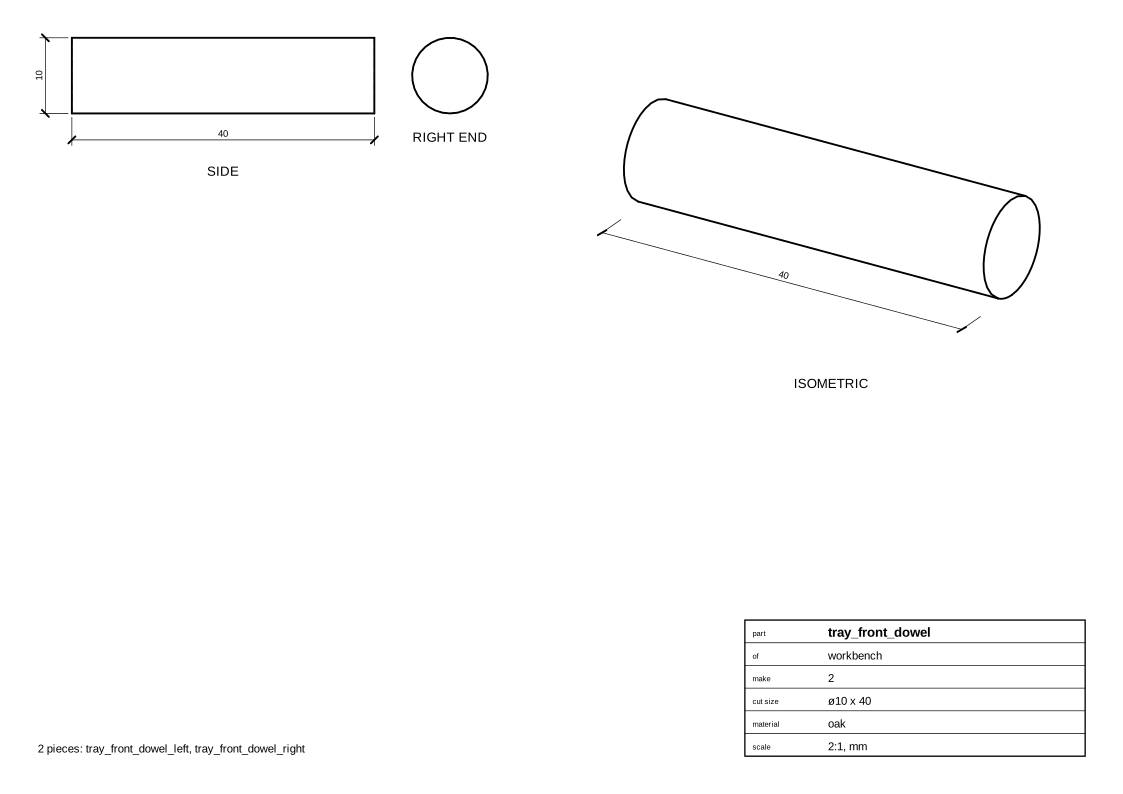
Tray front dowel
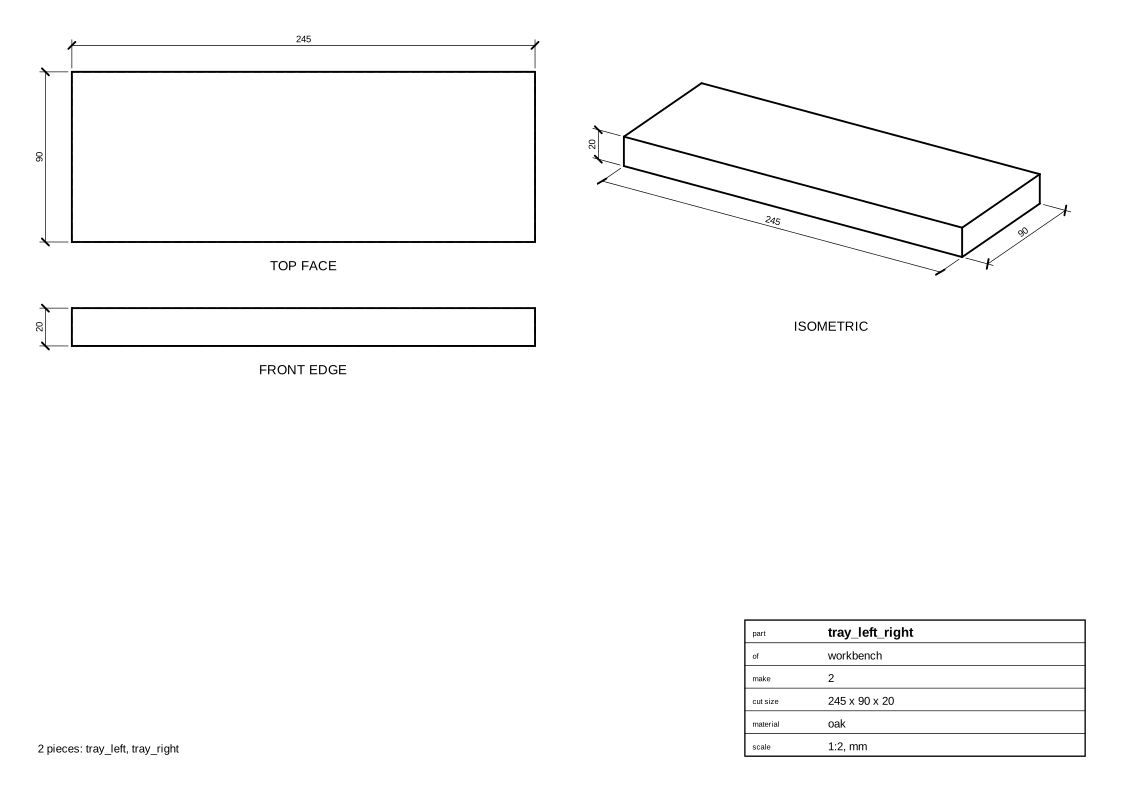
Tray left right
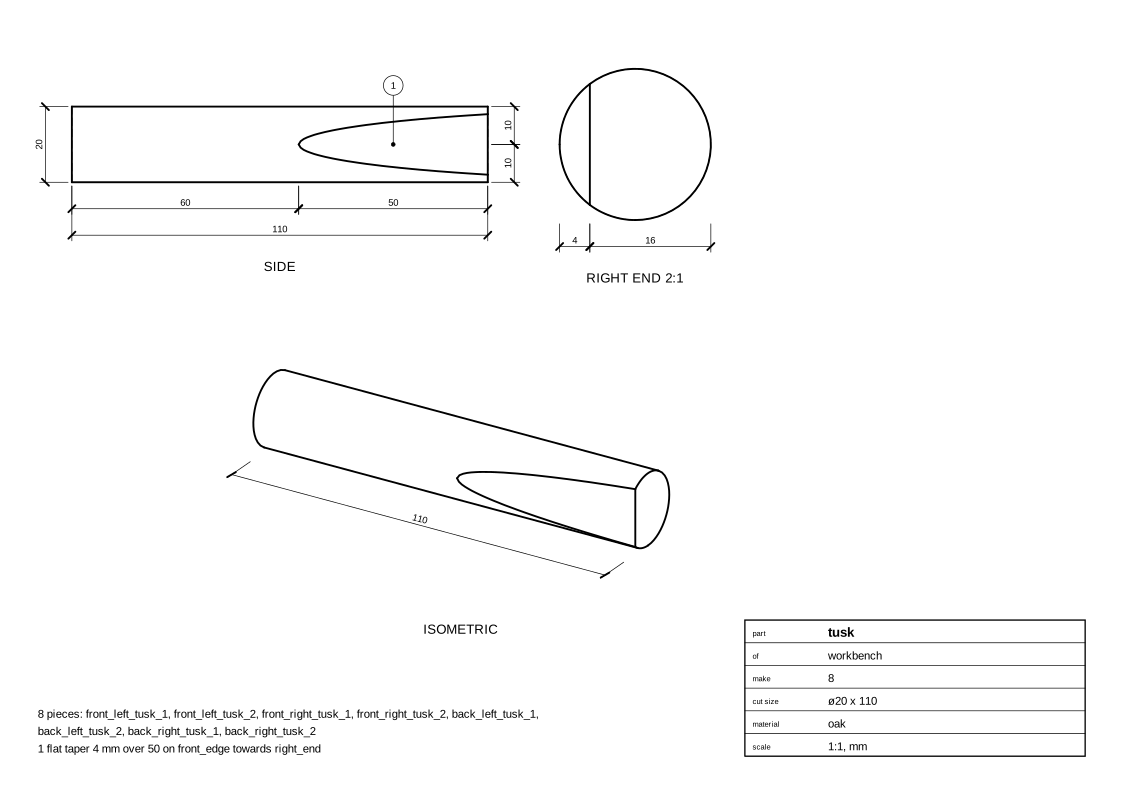
Tusk
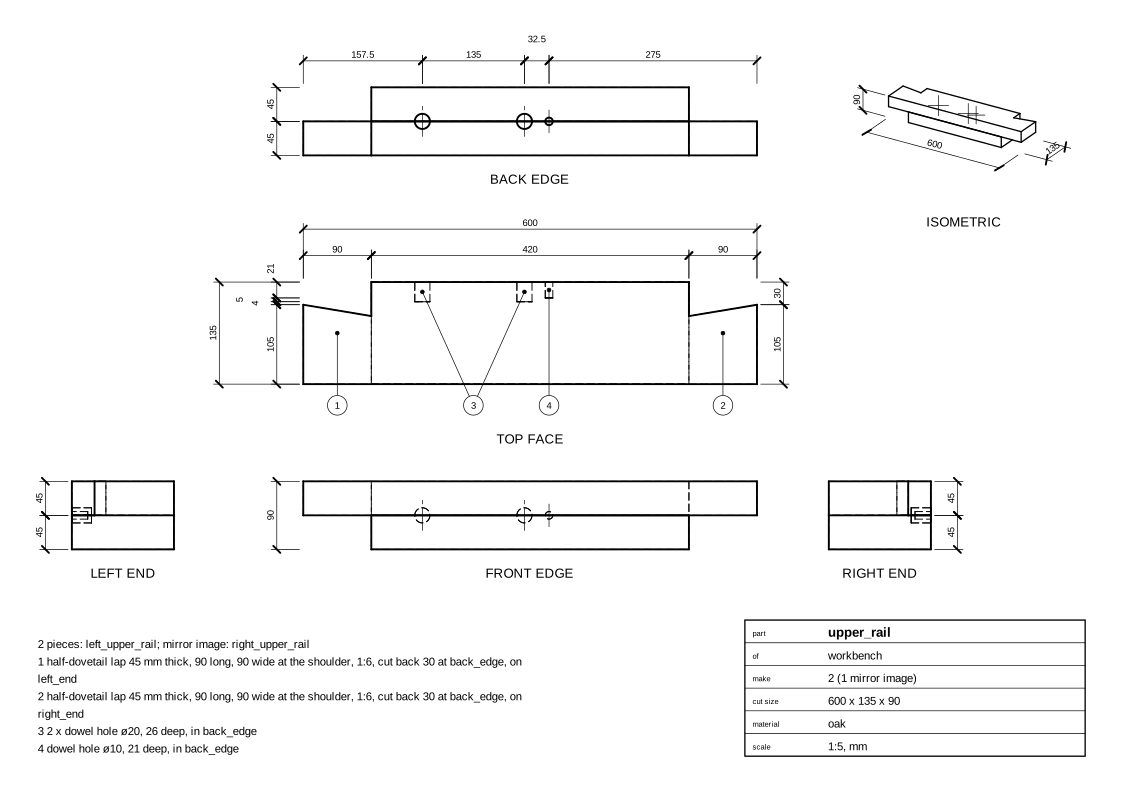
Upper rail
Cut list
leg                 810 x 90 x 90 mm  oak, glued up from 2 boards 810 x 90 x 45 mm, 4 pieces: left_front_leg, right_back_leg; mirror image: left_back_leg, right_front_leg
                    - chamfer 5 mm around left_end
                    - dado 90 mm, 22.5 deep, in top_face
                    - dovetail socket 90 to 105 mm, 22.5 deep, 1:6, in bottom_face, 30 mm short of right_end
                    - through mortise 100 x 45 mm in bottom_face
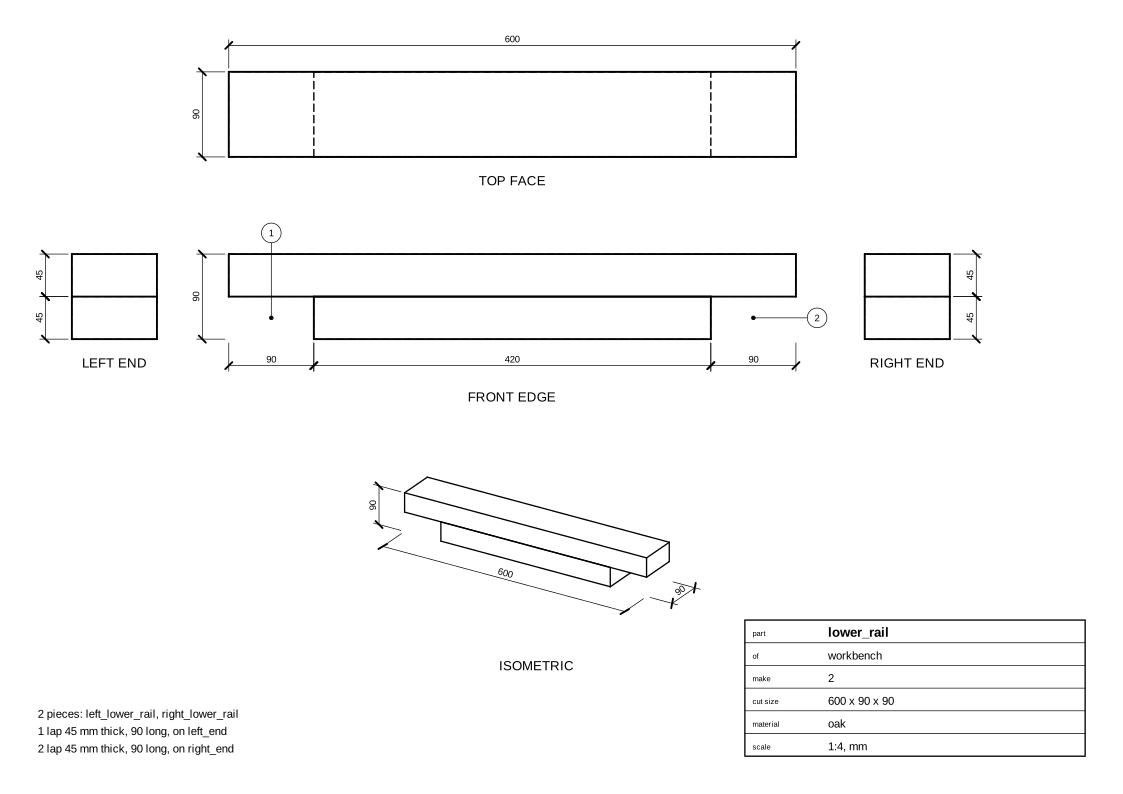
lower_rail          600 x 90 x 90 mm  oak, glued up from 2 boards 600 x 90 x 45 mm, 2 pieces: left_lower_rail, right_lower_rail
                    - lap 45 mm thick, 90 long, on left_end
                    - lap 45 mm thick, 90 long, on right_end
upper_rail          600 x 135 x 90 mm  oak, glued up from 2 boards 600 x 135 x 45 mm, 2 pieces: left_upper_rail; mirror image: right_upper_rail
                    - half-dovetail lap 45 mm thick, 90 long, 90 wide at the shoulder, 1:6, cut back 30 at back_edge, on left_end
                    - half-dovetail lap 45 mm thick, 90 long, 90 wide at the shoulder, 1:6, cut back 30 at back_edge, on right_end
                    - 2 x dowel hole ø20, 26 deep, in back_edge, 67.5 and 202.5 from left_end; centered
                    - dowel hole ø10, 21 deep, in back_edge, 235 from left_end, centered
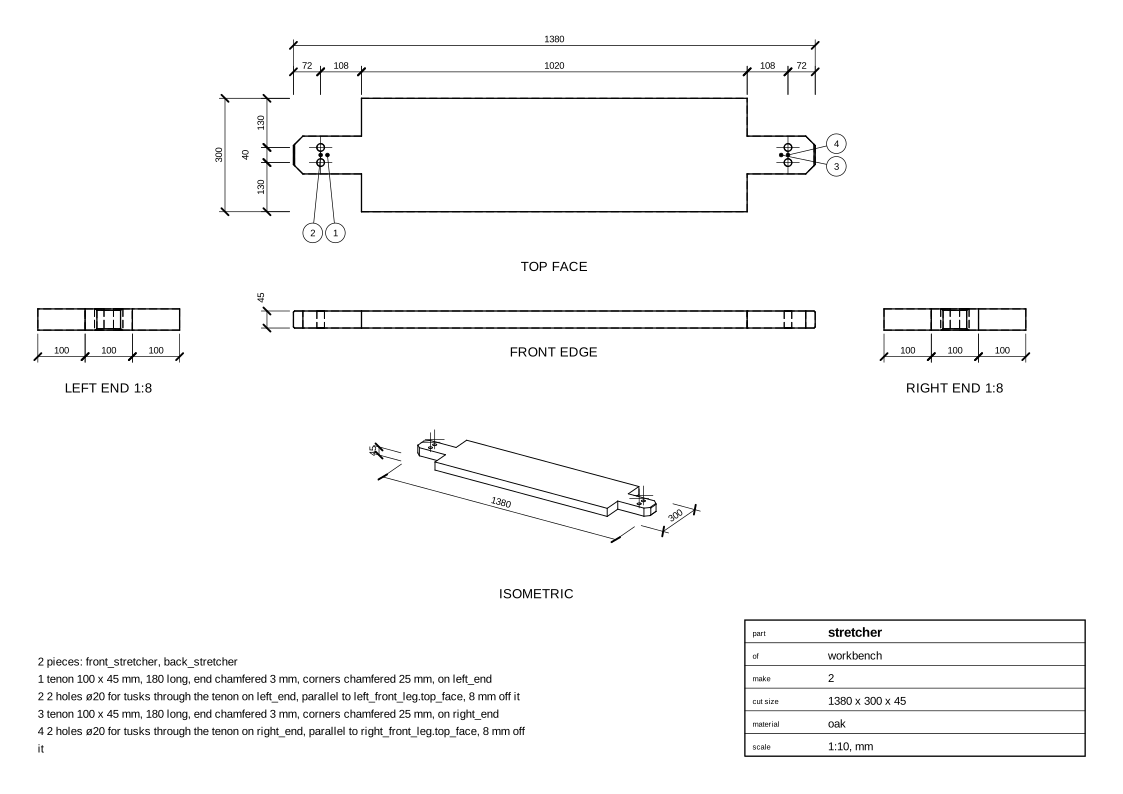
stretcher           1380 x 300 x 45 mm  oak, 2 pieces: front_stretcher, back_stretcher
                    - tenon 100 x 45 mm, 180 long, end chamfered 3 mm, corners chamfered 25 mm, on left_end
                    - 2 holes ø20 for tusks through the tenon on left_end, parallel to left_front_leg.top_face, 8 mm off it
                    - tenon 100 x 45 mm, 180 long, end chamfered 3 mm, corners chamfered 25 mm, on right_end
                    - 2 holes ø20 for tusks through the tenon on right_end, parallel to right_front_leg.top_face, 8 mm off it
tusk                ø20 x 110 mm  oak, 8 pieces: front_left_tusk_1, front_left_tusk_2, front_right_tusk_1, front_right_tusk_2, back_left_tusk_1, back_left_tusk_2, back_right_tusk_1, back_right_tusk_2
                    - flat taper 4 mm over 50 on front_edge towards right_end
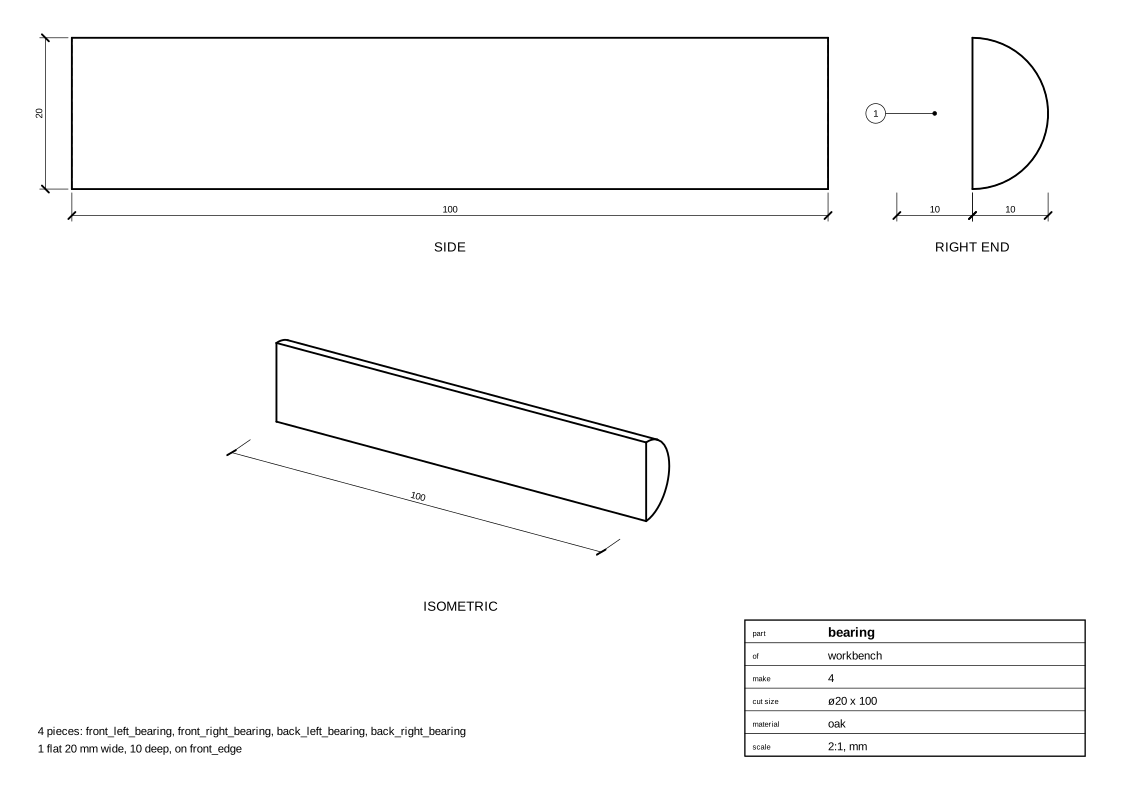
bearing             ø20 x 100 mm  oak, 4 pieces: front_left_bearing, front_right_bearing, back_left_bearing, back_right_bearing
                    - flat 20 mm wide, 10 deep, on front_edge
top_beam_1_2_3_5_6  2000 x 90 x 45 mm  oak, 5 pieces: top_beam_1, top_beam_2, top_beam_3, top_beam_5, top_beam_6
top_beam_4_7        2000 x 90 x 45 mm  oak, 2 pieces: top_beam_4, top_beam_7
                    - 2 x dowel hole ø20, 26 deep, in front_edge, 467.5 and 1532.5 from left_end; centered
tray_front_back     2000 x 90 x 20 mm  oak, 2 pieces: tray_front, tray_back
                    - 2 x dowel hole ø10, 21 deep, in front_edge, 467.5 and 1532.5 from left_end; centered
tray_left_right     245 x 90 x 20 mm  oak, 2 pieces: tray_left, tray_right
tray_bottom         1960 x 245 x 20 mm  oak
top_beam_dowel      ø20 x 50 mm  oak, 4 pieces: top_beam_4_dowel_left, top_beam_7_dowel_left, top_beam_4_dowel_right, top_beam_7_dowel_right
tray_front_dowel    ø10 x 40 mm  oak, 2 pieces: tray_front_dowel_left, tray_front_dowel_right
Code
From woodwright/examples/projects.py, which imports the names it uses (see From an example to your own design):
def workbench(
    length: float = 2000,
    depth: float = 600,
    height: float = 900,
    overhang: float = 400,
    stretcher_width: float = 300,
    stretcher_height: float | None = None,
    lower_rail_height: float = 120,
    leg_cap: float = 30,
    tusks: int = 2,
    top_beams: int = 7,
    tray_thickness: float = 20,
) -> Assembly:
    """A knock-down workbench, an approximation of Rex Krueger's Quick Stack
    workbench (get his plans for the real thing, at rexkrueger.com).

    Two leg assemblies, `length` - 2 x `overhang` apart over the outsides of
    the legs, are joined by two wide stretchers with tusk tenons, and carry
    a split top `height` above the floor: a massive desk at the front and a
    tray (a drawer-like box) at the back, flush with the legs at the front
    and the back, `depth` deep, `overhang` beyond the legs at each end.

    Each leg assembly: two 90 mm square legs, their feet chamfered, and two
    rails from front to back, all glued up from two 45 mm boards (the legs'
    glue lines on their sides, the rails' upright), the rails flush
    with the legs' front and back, lapped across the legs but let in only
    partly: the rails are cut to half their thickness, the legs notched a
    quarter of theirs, so the rails stand out of the legs by a quarter. The
    lower rail, as square as the legs, is on the outside, `lower_rail_height`
    above the floor. The upper one, 90 x 135 mm, on the inside and flush
    with the tops of the legs, has its laps cut to half dovetails, flat at
    the bottom and sloped at the top: the laps are cut back `leg_cap` from
    the top, so that the legs keep a solid cap above the notches.

    The stretchers, 45 mm thick and `stretcher_width` wide, stand on the
    lower rails (or `stretcher_height` above the floor). Their long through
    tenons, as thick as the stretchers and a third as wide, stand out of the
    legs by as much as the legs are wide, their corners chamfered big. Each
    tenon is held by `tusks` dowel tusks (in the second and the fourth fifth
    of the tenon), level through its thickness, their heads to the front:
    20 mm dowels a bit longer than the legs are wide, their flats tapering
    over 50 mm at their tips, bearing on a half dowel glued flat side down
    on the leg behind the tenon.

    The desk is glued up from `top_beams` 45 x 90 mm beams standing on edge
    (as "2x4s"). The tray, of `tray_thickness` boards, has walls as high as
    the desk is thick and a bottom between them, flush with their lower
    edges, so that it can be turned over: open side up it holds tools,
    upside down it is a flat part of the top. Both sit on the legs and the
    upper rails, located by short dowels in the rails: two 20 mm ones into
    the desk (into two of its beams) and a 10 mm one into the tray's front
    wall on each rail; the back wall has matching holes in its top edge for
    the tray turned over.
    """
    leg_size, beam = BENCH_LEG_STOCK.thickness, BENCH_STOCK.thickness
    beam_height = 2 * beam
    leg_length = height - beam_height
    span = length - 2 * overhang  # over the outsides of the legs
    if stretcher_height is None:
        stretcher_height = lower_rail_height + leg_size
    root = orient(at=(overhang, 0, 0), right_end=UP, top_face=LEFT)
    asm = Assembly("workbench", root_location=root)

    # The leg assemblies; the right one is the mirror image of the left one.
    legs: dict[str, dict[str, Board]] = {}
    upper_rails: dict[str, Board] = {}
    lap = dict(lap_thickness=leg_size / 2, over=True, proud=leg_size / 4)
    for side, mirror in [("left", False), ("right", True)]:
        front, back = (
            asm.add(
                Board(
                    f"{side}_{end}_leg",
                    BENCH_LEG_STOCK,
                    leg_length,
                    leg_size,
                    mirror=mirror,
                    plies=2,
                    plies_across="width",
                )
            )
            for end in ("front", "back")
        )
        legs[side] = {"front": front, "back": back}
        for leg in (front, back):
            leg.cut(EndChamfer(leg.left_end, size=5))
        between = depth - 2 * leg_size
        lower, upper = (
            asm.add(
                Board(
                    f"{side}_{level}_rail", BENCH_LEG_STOCK, between, width, mirror=mirror, plies=2
                )
            )
            for level, width in [("lower", leg_size), ("upper", 1.5 * leg_size)]
        )
        upper_rails[side] = upper
        for end, leg in [(lower.left_end, front), (lower.right_end, back)]:
            asm.join(
                HalfLap(
                    lap=end,
                    socket=leg.back_edge if leg is front else leg.front_edge,
                    position=offset(lower_rail_height, ref=leg.left_end),
                    flush=(leg.top_face, lower.top_face),
                    **lap,
                )
            )
        for end, leg in [(upper.left_end, front), (upper.right_end, back)]:
            asm.join(
                DovetailHalfLap(
                    lap=end,
                    socket=leg.back_edge if leg is front else leg.front_edge,
                    position=flush_with(leg.right_end),
                    flush=(leg.bottom_face, upper.top_face),
                    stopped={leg.right_end: leg_cap},
                    slope=6,
                    sloped=(upper.back_edge,),
                    **lap,
                )
            )

    # The stretchers, their reference faces outside, through the inner faces of the legs.
    tenon_width = stretcher_width / 3
    for end in ("front", "back"):
        stretcher = asm.add(
            Board(f"{end}_stretcher", BENCH_STOCK, span - 2 * leg_size, stretcher_width)
        )
        for side, tenon in [("left", stretcher.left_end), ("right", stretcher.right_end)]:
            leg = legs[side][end]
            name = f"{end}_{side}"
            tusk_rods = tuple(
                asm.add(Rod(f"{name}_tusk_{i + 1}", BENCH_DOWEL_STOCK, length=110))
                for i in range(tusks)
            )
            bearing = asm.add(Rod(f"{name}_bearing", BENCH_DOWEL_STOCK, length=tenon_width))
            asm.join(
                DowelTuskTenon(
                    tenon=tenon,
                    mortise=leg.bottom_face,
                    position=offset(stretcher_height, ref=leg.left_end),
                    flush=(
                        (leg.front_edge, stretcher.top_face)
                        if end == "front"
                        else (leg.back_edge, stretcher.top_face)
                    ),
                    across=CENTERED,
                    shoulder=(stretcher_width - tenon_width) / 2,
                    tenon_thickness=beam,
                    tenon_chamfer=3,
                    tenon_corner_chamfer=25,
                    tusks=tusk_rods,
                    bearings=(bearing,),
                    tusk_head=leg.front_edge,
                    tusk_slope=12.5,
                    flat_length=50,
                    protrusion=leg_size,
                )
            )

    # The desk: beams on edge, their reference faces to the front, glued face to face.
    beams = [
        asm.add(Board(f"top_beam_{i + 1}", BENCH_STOCK, length, beam_height))
        for i in range(top_beams)
    ]
    for a, b in itertools.pairwise(beams):
        asm.join(Butt(a.bottom_face, b.top_face))

    # The tray: the front and the back as long as the bench, the ends between
    # them, the bottom between all four, flush with their lower edges; the
    # reference faces outside.
    tray_stock = Stock.board(thickness=tray_thickness, species="oak")
    tray_front_y = top_beams * beam
    tray_depth = depth - tray_front_y
    inside = tray_depth - 2 * tray_thickness
    tray_front, tray_back = (
        asm.add(Board(f"tray_{end}", tray_stock, length, beam_height)) for end in ("front", "back")
    )
    tray_ends = []
    for end in ("left", "right"):
        wall = asm.add(Board(f"tray_{end}", tray_stock, inside, beam_height))
        tray_ends.append(wall)
        asm.join(
            Butt(
                tray_front.bottom_face,
                wall.left_end,
                position=flush_with(getattr(tray_front, f"{end}_end")),
                flush=(tray_front.front_edge, wall.front_edge),
            )
        )
    for wall, outer in zip(
        tray_ends, (tray_ends[0].bottom_face, tray_ends[1].top_face), strict=True
    ):
        asm.join(
            Butt(
                wall.right_end,
                tray_back.bottom_face,
                position=flush_with(outer),
                flush=(wall.front_edge, tray_back.front_edge),
            )
        )
    bottom = asm.add(Board("tray_bottom", tray_stock, length - 2 * tray_thickness, inside))
    asm.join(
        Butt(
            tray_front.bottom_face,
            bottom.front_edge,
            flush=(tray_front.front_edge, bottom.bottom_face),
        )
    )

    # Dowels into the tops of the upper rails, which start behind the front
    # legs (at y = leg_size), in line with the legs but for the quarter
    # standing out of them.
    for side in ("left", "right"):
        rail = upper_rails[side]
        inner = overhang + leg_size if side == "left" else length - overhang - leg_size
        x = inner - 3 * leg_size / 4 if side == "left" else inner - leg_size / 4
        # A thinner dowel into the tray's wall, a third of its thickness.
        for board, front_y, stock, dowel_length in [
            (beams[top_beams // 2], top_beams // 2 * beam, BENCH_DOWEL_STOCK, 50),
            (beams[-1], (top_beams - 1) * beam, BENCH_DOWEL_STOCK, 50),
            (tray_front, tray_front_y, TRAY_DOWEL_STOCK, 40),
        ]:
            dowel = asm.add(Rod(f"{board.name}_dowel_{side}", stock, length=dowel_length))
            asm.join(
                Dowels(
                    board.front_edge,
                    rail.back_edge,
                    dowels=(dowel,),
                    offsets=(front_y + board.thickness / 2 - leg_size,),
                    flush=(board.top_face, rail.left_end),
                    across=offset(leg_size - front_y),
                    position=offset(x, ref=board.left_end),
                )
            )
        # The tray's back wall comes over the rail when the tray is turned over.
        tray_back.cut(
            Hole(
                tray_back.back_edge,
                TRAY_DOWEL_STOCK.diameter,
                depth=21,
                at={tray_back.left_end: length - x - leg_size / 2},
                kind="dowel hole",
                note="for the tray turned over",
            )
        )
    return asm
Exported with woodwright 0.9.0 on 2026-10-25.